

The short answer is yes. But if you are asking the question, you are likely looking at it through the lens of traditional window cleaning. You are picturing a squeegee, a bucket, and a worker suspended hundreds of feet in the air.
Take a different view. The reality of high-rise maintenance is no longer just about glass; it is about the entire building. When you look past the second storey of a building, traditional methods, like scaffolding, cradle systems, or boom lifts become slow, dangerous, and are incredibly expensive.
Drone cleaning isn’t the future, it is now. It can complete a greater range of cleaning tasks faster, safer, and more effectively than traditional methods. Here is exactly how it works, why the technology has finally caught up to the demand, and what the commercial reality looks like on the ground.
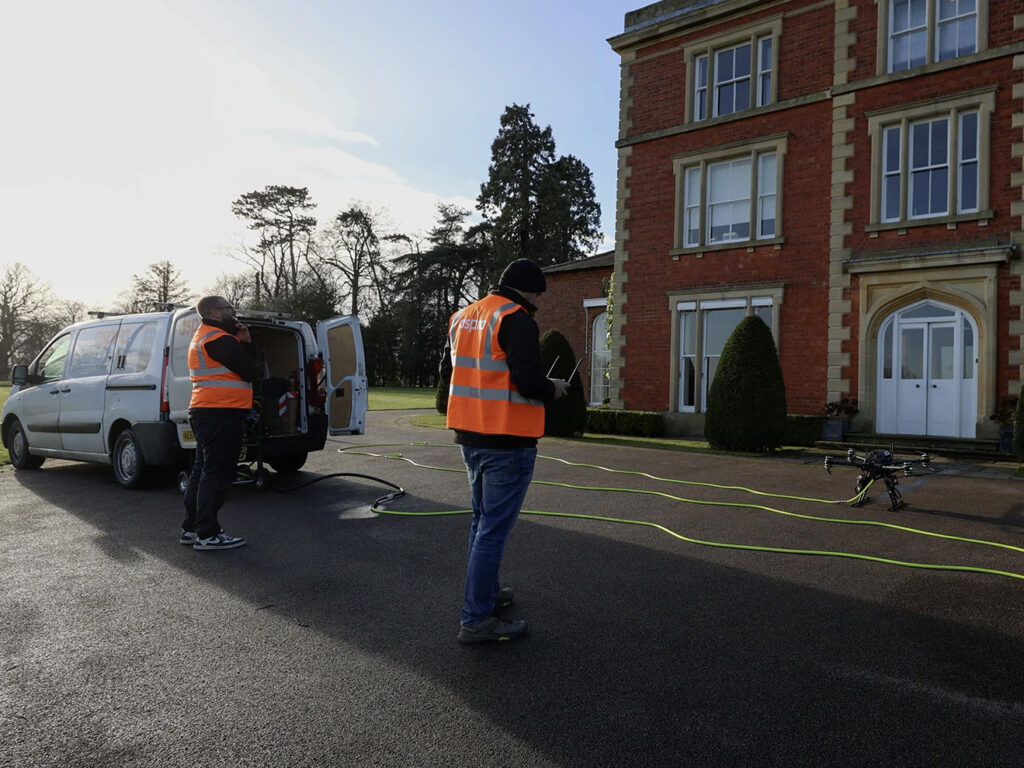
Flow Rate Cleans, Not Pressure
The biggest misconception about drone cleaning is that you are just flying a standard pressure washer into the sky. In reality, hitting any window with intense, concentrated pressure is a recipe for broken seals and property damage.
The industry authority is clear: flow rate cleans, not pressure.
Instead of relying on physical scrubbing or potentially destructive pressure, purpose-built industrial drones utilise advanced soft-wash techniques. By delivering high-volume, de-ionised, and slightly heated water through specialised filters, the drone lifts away grime and particulates naturally. For stubborn algae or organic buildup, operators apply environmentally friendly chemical solutions like Wet & Forget to do the heavy lifting, ensuring the glass and facade are left completely streak-free without a squeegee ever touching the surface.
The Physics of Flight: 3:1 Power and Surface Tracking
Carrying high-volume water up multiple storeys creates immense physical drag. The weight of the hose constantly pulls down on the aircraft. If you simply strap a hose to an off-the-shelf camera drone like a DJI M350, the system will struggle, drift, and potentially could crash under the strain.
To handle this payload safely, you need a heavy-duty octocopter designed from the ground up for industrial washing. While a standard drone might offer a 2:1 power-to-weight ratio, flagship British-engineered systems like the Aspira AC 4.2 and AC Ultimate boast a 3:1 power-to-weight ratio. This massive power reserve keeps the aircraft stable, even with high flow rates.
Furthermore, these drones do not rely on a pilot’s manual joystick adjustments to stay level with the glass. They utilise CLIVE (Cameras, Sensors, and Radar) to drive advanced control algorithms. This powers Advanced Surface Tracking, allowing the drone to lock onto a surface and maintain the mathematically perfect cleaning distance autonomously, even if a sudden gust of wind hits.
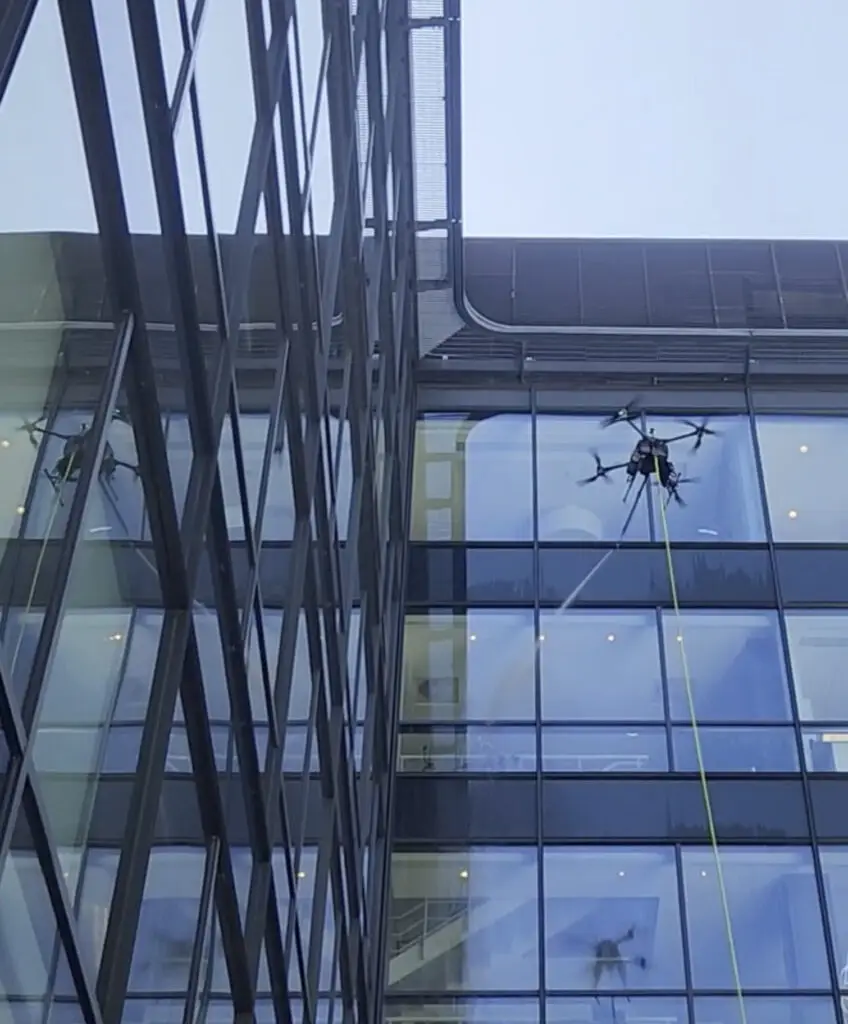
Operating in Dense Urban Environments: GPS-Denied Flight
High-rise buildings are rarely sitting isolated in empty fields. They are usually crammed into dense urban environments, surrounded by steel structures and concrete canyons that cause severe GPS signal degradation and magnetic interference.
If a drone relies entirely on GPS, a signal drop or electromagnetic interference from hospitals and steel frames means a critical failure. The drone can easily lose its positioning, causing it to enter an erratic, spiralling drift or violently “leap” sideways as the flight controller attempts to correct itself against corrupted data.
This triggers an automated panic response that forces it to abort the mission, leaving operators completing only 80% to 90% of a job and completely defeating the purpose of hiring them.
The Aspira AC Ultimate solves this by offering full GPS-denied capability. When the satellite signal is not available or reliable, the CLIVE GPS denied setting can be enabled to provide real-time pixel mapping through sensors and Radar to maintain absolute stability. It finishes 100% of the job, safely, where lesser drones simply cannot fly.
The Verdict
Can drones really clean high-rise windows? Not only can they do it, but they are actively replacing legacy, high-risk manual cleaning across complex infrastructure globally.
By combining purpose-built British engineering with intelligent flight automation, drones have transformed building maintenance from a dangerous logistical headache into a highly efficient, push-button commercial operation. The technology isn’t a future projection; it is on-site, right now.


